
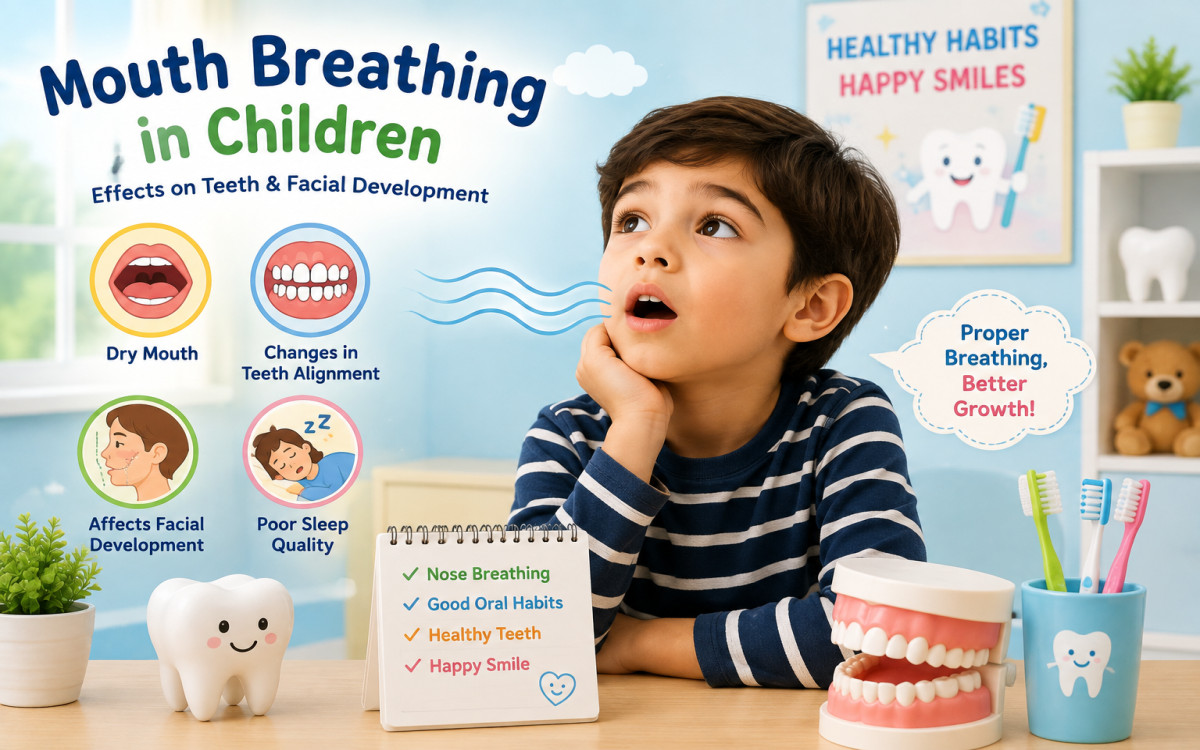
Can Mouth Breathing Affect Your Teeth and Facial Development?
Respiration is an activity we engage in subconsciously. While nose respiration is usually considered to be healthy, there are children who consistently resort to mouth respiration, especially during the sleep period.
Respiration via the mouth on an occasional basis could be due to a common cold or congested nose. However, mouth breathing on a consistent basis could occasionally be linked to xerostomia, dental complications, sleep-related issues, and even dental growth.
If you have noticed that your child is consistently breathing from their mouth while sleeping or even during the daytime, it would be good to consult a dental practitioner.
What Is Mouth Breathing?
When someone breathes out of their mouth rather than their nose on a regular basis, this is mouth breathing.
This might be a temporary problem caused by nasal congestion, allergies, or a cold. There are, however, some cases where children have trouble breathing out of their mouth because of adenoids or tonsil enlargement, nasal blockage, etc.
A dental evaluation can reveal any issues mouth breathing is causing to the child's oral health.
Signs That Your Child May Be a Mouth Breather
Some of the common signs parents may observe in children, especially during sleep, include:
Mouth breathing during sleep
Dry mouth or dry lips
Snoring
Audible breathing during sleep
Mouth drooling during sleep
Nasal blockage
Challenged ability to keep their mouth closed
Tooth misalignment or malocclusion
Oral pain
The above signs do not automatically indicate a dental issue in your child. However, it would be prudent to have these checked out.
What Are The Effects Of Mouth Breathing On Oral Health?
Mouth breathing may lead to mouth dryness over time. Saliva plays an important role in protecting teeth.
If the mouth is dry all the time, it may become hard to deal with the plaque build-up, which might result in halitosis or cavities.
Teeth cleaning and brushing are thus necessary for children that often suffer from mouth dryness.
It is also important for parents to bring their children for dental check-ups to detect any dental development problems in time.
Could Mouth Breathing Influence Tooth Formation?
This is especially important in young children, as the development of the teeth, jaws, and other facial structures is ongoing.
In some cases, mouth breathing can be linked to problems with oral posture such as tongue positioning, lip positioning, and jaw positioning, which may result in the formation of an improper bite or alignment of the teeth.
Mouth breathing does not appear to be the only factor at play, however, as genetics, jaw formation, oral habits, and other factors can impact tooth alignment as well.
It is for this reason that parents should not think that all mouth breathers will develop crooked teeth.
Why Early Dental Checkup is Important
In case your child breathes using his or her mouth on a regular basis, a dental checkup at an early age will help figure out if there is anything to worry about when it comes to the teeth, gums, bite, or overall development of the mouth.
A best child dentist specialist can evaluate your child's dental development and identify any concerns related to the teeth, gums, bite, or overall oral development.
What Can Parents Do to Assist?
Parents can help promote oral health in children through promoting good practices.
This includes:
Brushing twice daily with fluoride toothpaste
Flossing in the right manner
Drinking adequate amounts of water
Visiting the dentist on a regular basis
Following instructions from experts in dealing with constant nasal congestion
Noticing changes in the position of teeth or occlusion
Additionally, parents need to stop forcing their children to keep their mouth closed while sleeping. Instead, constant mouth breathing should be brought to the attention of the relevant experts.
What Time Should You See a Dentist?
You should consider getting a check-up if your kid is having any of the following symptoms:
Sleeps with an open mouth
Frequently snores
Consistently dry mouth
Regular dental problems
Changes in their bite/tooth formation
Difficulty breathing via the nose
In case you are looking for the best dental clinic near me, pick one that evaluates your kid's dental growth.
Can Mouth Breathing Cause Tooth Pain?
In itself, mouth breathing may not directly cause tooth pain. Nevertheless, chronic dryness of the mouth may create conditions that lead to dental issues.
For instance, child tooth pain cavity can occur because of tooth decay, while mouth breathing alone cannot be considered the direct cause of the problem. Other causes of tooth pain may include infection, sensitivity, or dental injury.
Frequently Asked Questions
1. Is mouth breathing common in children?
It is not unusual for children to breathe through their mouths occasionally during a cold, allergy, or when there is an obstruction in the nose. It is advisable to have the situation assessed to find out the underlying reasons.
2. Will mouth breathing lead to crooked teeth?
Breathing through one’s mouth does not necessarily result in crooked teeth. Breathing through one’s mouth on a continuous basis is usually associated with oral problems in some children.
3. Does mouth breathing lead to dry mouth?
Yes, it does. The reason is that breathing through one’s mouth results in dryness since air keeps flowing through the mouth.
4. Is there any possibility that mouth breathing can lead to dental problems?
Mouth breathing on a continuous basis usually results in dryness, making it hard for someone to have healthy oral conditions. One needs to brush regularly and keep visiting the dentist.
5. Under what circumstances should I take my kid to a dentist because of mouth breathing?
In case your child breathes through the mouth while sleeping, snores, suffers from constant dryness of the mouth, or exhibits any abnormalities in teeth alignment, it would be wise to take him/her for a dental checkup.
6. Does mouth breathing lead to tooth pain in children?
Mouth breathing does not always cause toothache in children. In case your child experiences tooth pain, you can visit a dentist who will investigate further to establish the cause.
Conclusion
However, mouth breathing should not necessarily be perceived as just a bad habit among children. Sometimes it could have something to do with dryness, dental complications, or even dental development.
Early detection of the cause, proper oral hygiene, and regular dental visits will aid in achieving healthy teeth and gums while your child is growing up.
If you have any concerns regarding mouth breathing, teeth alignment, or oral health in general, then it is advisable to see a dentist